A custody journal can help you turn scattered memories, messages, and calendar entries into a clear record of parenting time and child-related events. This US-focused guide explains what to record, how to write factual entries, how to preserve supporting material, and what can weaken credibility later.
This article provides general information for parents in the United States and is not legal advice. Evidence rules and family-court procedures vary by state, county, court, and case.
If parenting time is part of the dispute, start with our guide on how to track parenting time after divorce. DivKids also provides a private place to organize dated notes, parenting-time records, expenses, and attachments at DivKids.
This guide uses the Federal Rules of Evidence as a general framework for concepts such as personal knowledge, authentication, hearsay, recorded recollection, and summaries. Those federal rules do not automatically govern state family-court proceedings, so always check your state rules, local court instructions, and advice from a qualified family-law attorney.
TL;DR
Write custody-journal entries as soon as possible after an event, using exact dates, times, locations, and facts you personally observed. Link important entries to original texts, emails, calendar records, receipts, school notices, or photos. Do not assume that a journal, app, or PDF report will automatically be admitted in court.
Quick answer
A useful custody journal is a dated, chronological record of parenting-time exchanges, schedule changes, important communication, child-related decisions, expenses, and other events that may matter in mediation or family court. Its value comes from consistency, factual language, and supporting records.
- What to record: events connected to parenting time, the child’s care, important decisions, and compliance with an order or agreement.
- How to document it: write a short factual entry and connect it to the original message, document, receipt, calendar item, or photo.
- What manual notes can miss: after several months, paper notebooks and scattered spreadsheets can make attachments, dates, and context difficult to match.
Key points
- Write the entry on the same day when possible, while details are still fresh.
- Use exact dates and times instead of phrases such as „late again” or „always cancels.”
- Separate what you personally observed from what another person told you.
- Use one entry for one event and give each supporting file a matching reference.
- Preserve full message threads instead of relying only on cropped screenshots.
- Review the journal once a month for missing dates, attachments, or unexplained gaps.
- A summary report can make records easier to review, but it does not replace the underlying material.
- A journal may support preparation and testimony, but admissibility depends on local law and procedure.
Table of contents
- TL;DR
- Quick answer
- Key points
- What is a custody journal?
- What should you write?
- How do you write credible entries?
- Custody journal example entries
- Is a parenting journal admissible?
- How should you preserve records?
- Common mistakes
- How to handle it in practice
- When should you contact a lawyer?
- Sources and legal framework
- Key takeaways
What is a custody journal?
A custody journal, parenting journal, or custody diary is a private chronological record of events connected to parenting arrangements and the child’s care. It is not a special court form and it is not proof simply because it exists.
The journal can help you prepare for a lawyer meeting, mediation, a custody evaluation, or a hearing. It can also help you compare what happened with the parenting plan, calendar, and original communication.
When the main issue is the actual amount of time spent with the child, a structured parenting time tracker may be easier to review than a long narrative diary.
What should you write in a custody journal?
Record events that are relevant to parenting arrangements or the child’s welfare. Routine entries matter too because they show that the journal is a continuing record, not a list created only to document the other parent’s mistakes.
- Completed, missed, shortened, or rescheduled parenting time.
- Scheduled and actual pickup or drop-off times and locations.
- Late arrivals, early returns, cancellations, and proposed replacement time.
- Important messages about school, health care, transportation, activities, or travel.
- Medical appointments, school meetings, attendance issues, and major decisions.
- Child-related expenses when they matter to the dispute or agreement.
- Relevant incidents you personally observed, including who was present.
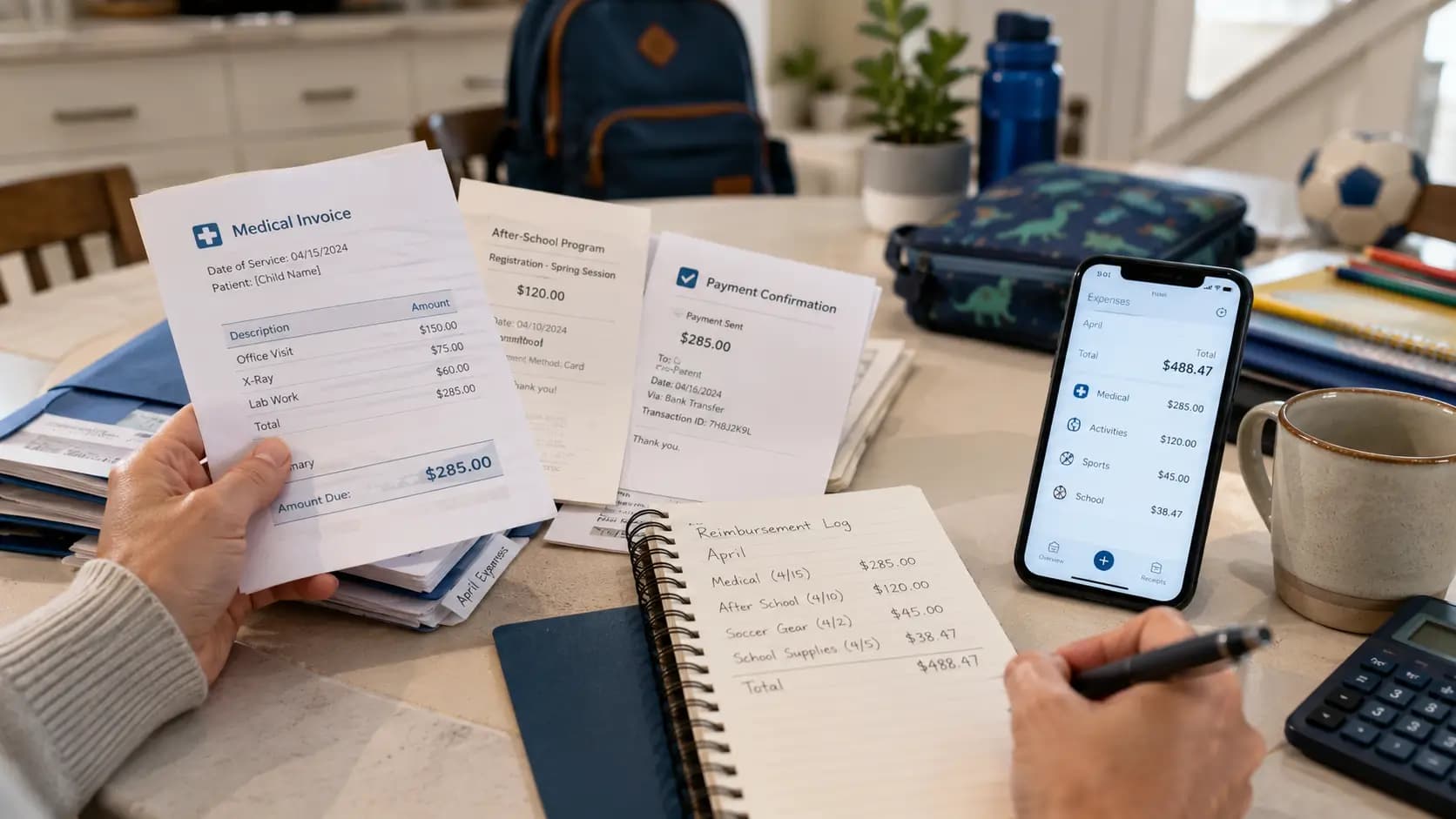
For financial records, use a separate expense history and connect each amount to a receipt or payment record. Our guide on how to document child expenses after divorce explains that workflow in more detail.
How do you write credible custody-journal entries?
Write promptly
Create the entry as soon as practical after the event. A short note written while the details are fresh is usually more reliable than a detailed reconstruction made several months later.
Use facts, not labels
Write what happened, not what you think it proves about the other parent’s personality or motives. Replace „She does not care about the schedule” with „Pickup was scheduled for 5:30 p.m.; arrival was at 6:08 p.m.”
Identify the source
If the information came from a text, email, school portal, medical office, or another person, identify that source. Do not rewrite another person’s statement as something you personally observed.
Keep the original context
Preserve the full message thread, not only the sentence that supports your position. Keep the original email, file, image, or portal notice whenever possible.
Use one repeatable format
- Date and time of the event.
- Scheduled arrangement, if relevant.
- What actually happened.
- Location and people present.
- Direct observation or identified source.
- Action taken afterward.
- Reference to supporting material.
Custody journal example entries
The examples below are fictional. They show a neutral structure and do not predict whether a court would admit or rely on a specific entry.
| Date and event | Factual entry | Supporting material |
|---|---|---|
| March 4, 2025 – exchange | Exchange was scheduled for 5:30 p.m. at Lincoln Elementary. I arrived at 5:24 p.m. The other parent arrived at 5:58 p.m., and the child entered my car at 5:59 p.m. I sent messages at 5:36 p.m. and 5:47 p.m. asking for an estimated arrival time. | Full text thread saved as CJ-2025-03-04-A. |
| April 11, 2025 – schedule change | At 8:14 a.m., the other parent asked by text to move pickup from 10:00 a.m. to 1:00 p.m. because of a soccer event. I agreed at 8:20 a.m. and updated the calendar. | Text thread and calendar entry saved as CJ-2025-04-11-B. |
| May 6, 2025 – school notice | At 2:40 p.m., the school portal reported that the child left early at 1:55 p.m. after visiting the nurse. I emailed the other parent at 3:05 p.m. asking whether follow-up care had been arranged. | Portal notice and email saved as CJ-2025-05-06-C. |
A factual entry does not need to be long. It needs enough detail to explain what happened and enough organization to locate the original support later.
Is a parenting journal admissible in court?
There is no universal yes-or-no answer. A journal may be useful for preparing testimony, refreshing memory, showing a chronology, or supporting an exhibit, but the court may still consider relevance, personal knowledge, authentication, hearsay, completeness, and local filing procedures.
The Federal Rules of Evidence provide a useful framework: Rule 602 addresses personal knowledge, Rule 803(5) addresses recorded recollection, Rule 901 addresses authentication, and Rule 1006 addresses summaries of voluminous records. Most custody cases are handled in state courts, which may use different rules or state versions of similar principles.
A same-day entry is not automatically admissible. A clean PDF summary is not automatically evidence of every event it lists. The underlying messages, documents, photos, and testimony may still matter, and the other side may challenge how the record was created or whether it is complete.
How should you preserve digital records?
Keep one chronology and use consistent file names. A simple reference such as CJ-2025-03-04-A lets you connect a journal entry to a message thread, image, email, or document without searching through the entire phone.
- Keep original messages and export full threads when possible.
- Save original files before editing, cropping, converting, or annotating them.
- Keep backups in a secure location with account protection enabled.
- Do not overwrite an old entry; add a dated correction that explains the change.
- Review whether sensitive child, medical, financial, or identifying information should be redacted before filing.
Shared communication tools can be useful for logistics, while private records serve a different purpose. See what co-parenting apps are good for and what should stay private.
Courts also differ in how they receive exhibits. The North Carolina Judicial Branch tells court users to print evidence stored on a phone, while Minnesota and Arizona courts use digital exhibit systems in some proceedings. Follow the instructions for your specific court instead of assuming that showing a phone to the judge will be enough.
Common custody-journal mistakes
- Writing only about negative events. A record that omits ordinary completed exchanges may appear selective.
- Using insults or diagnoses. Labels such as „narcissist,” „liar,” or „unstable” are not substitutes for observed facts.
- Back-filling months of entries. Reconstructed notes can be harder to explain and verify.
- Cropping away context. A partial screenshot can leave out messages that change the meaning.
- Mixing sources with observations. Clearly state whether you saw something, received a message, or heard it from another person.
- Treating a summary as the original proof. Keep the records behind every important line.
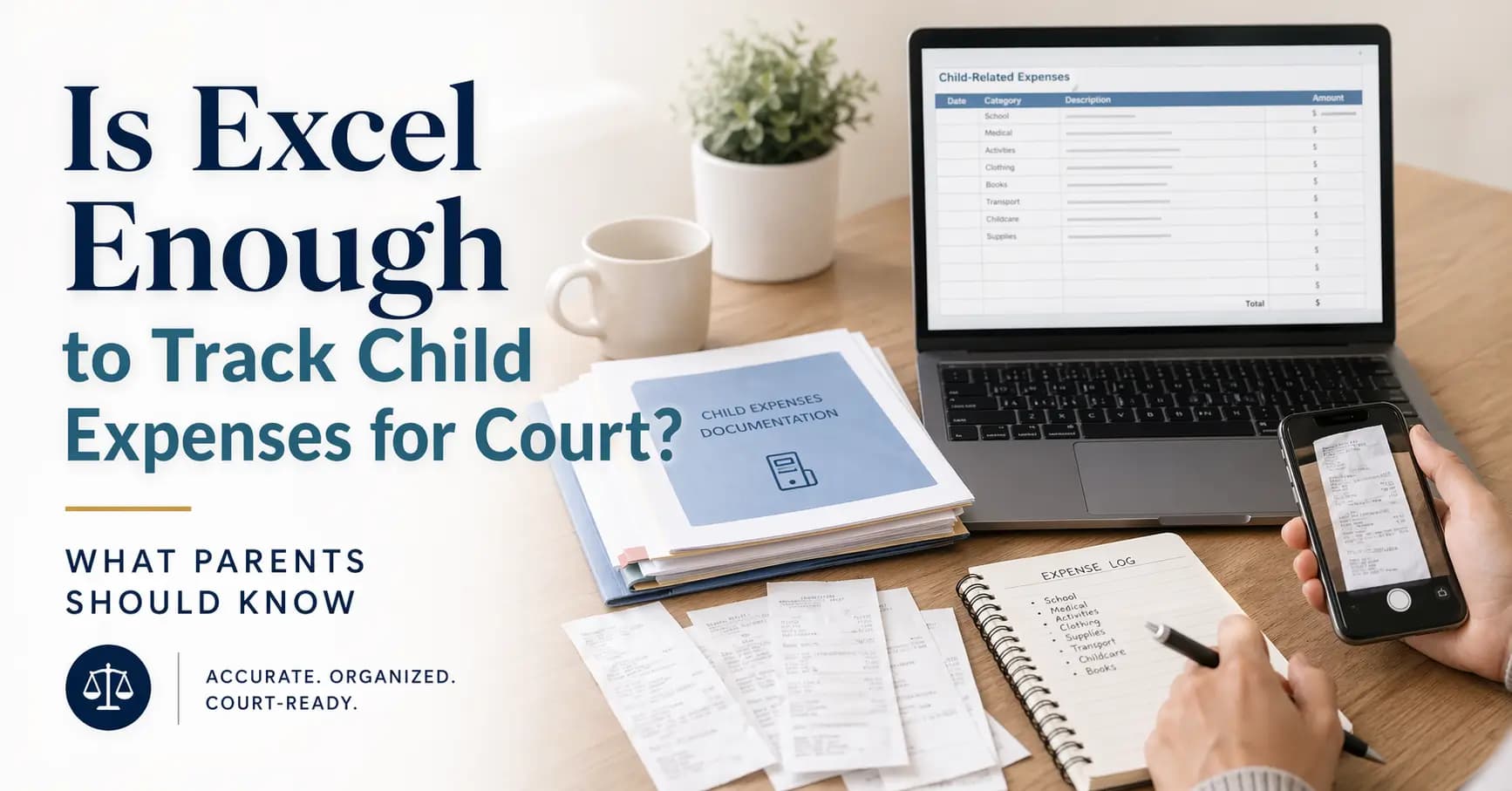
Spreadsheets can help with dates and totals, but they become weaker when attachments and context are stored elsewhere. The same organizational limits are explained in is Excel enough to track child expenses for court?
How to handle a custody journal in practice
- Choose one private place for the journal and supporting files.
- Create a standard entry format and use it every time.
- Record the event promptly and keep the description short.
- Attach or reference the original message, document, image, or calendar record.
- Review the journal monthly and export a dated backup or report.
DivKids can help organize dated Notes, parenting-time entries, attachments, child expenses, and PDF reports without requiring the other parent to share the account. The DivKids Notes and PDF reports guide shows how these records can be kept together.
A report should make the history easier to review, not make legal conclusions for the reader. Use neutral labels, clear date ranges, and direct references to the original records.
When should you contact a family-law lawyer?
Ask a qualified lawyer in your state how local rules apply before you file the journal, rely on recordings, disclose sensitive records, or prepare exhibits for a hearing. Legal review is especially important when the case involves abuse allegations, stalking, threats, relocation, possible abduction, serious neglect, or disputed medical information.
Do not delay an emergency response to create a better record. If anyone is in immediate danger, contact emergency services and follow the advice of appropriate local professionals.
Before a hearing, ask the lawyer or court clerk about exhibit deadlines, required copies, redaction rules, electronic filing, and whether the other party must receive the material in advance.
Sources and legal framework
- United States Courts – Federal Rules of Evidence
- North Carolina Judicial Branch – Going to Court Basic Information
- Minnesota Judicial Branch – Evidence and Exhibits
- Arizona Judicial Branch – Digital Evidence
These sources illustrate general evidence concepts and differences in court procedure. They do not replace the rules and instructions that apply to your own state, county, judge, or case.
Key takeaways
- A strong custody journal is prompt, factual, chronological, and connected to original supporting records.
- Use exact dates, times, locations, and direct observations instead of conclusions about motives or character.
- Keep full message threads, original files, and a consistent reference system for attachments.
- Review the journal monthly so missing entries and documents are found before they become difficult to recover.
- A summary or PDF can improve organization, but the underlying material still matters.
- Admissibility and court procedure depend on state law, local rules, and the purpose for which the journal is offered.
- If you want to organize records as they happen and keep a clear report ready, you can create a DivKids account.
Frequently Asked Questions
What is a custody journal?
What should I write in a custody journal?
How quickly should I update a custody journal?
Is a parenting journal admissible in court?
Should I include screenshots in a custody journal?
Can DivKids help organize a custody journal?