After divorce, shared child expenses can become confusing fast: one parent pays, the receipt sits in a phone gallery, and the reimbursement request is discussed weeks later. If you are still deciding which costs belong in your records, start with what counts as a child-related expense after divorce.
This guide explains how to track shared child expenses after divorce, calculate each parent’s share, send a clear reimbursement request, and keep a record of partial, disputed, or unpaid amounts. DivKids is a private option for keeping expenses, receipt photos, child profiles, notes, and dated history together.
This article provides general information for parents in the United States and is not legal advice.
Quick answer
To track shared child expenses after divorce, use the same record structure for every cost and connect each entry to the document or written agreement that supports reimbursement. Your court order, parenting plan, separation agreement, or divorce judgment may specify whether an expense is separate from regular child support, how it is divided, and whether approval, notice, or payment deadlines apply.
- What this covers: expenses that your order, agreement, or applicable state law treats separately from ordinary child support.
- How to document them: save the invoice or receipt, proof of payment, written approval when required, reimbursement request, and response.
- Where manual systems fail: spreadsheets and notes become difficult to use when receipts, messages, payment confirmations, and status updates are stored in different places.
Key points
- Read every controlling document before requesting reimbursement: the divorce judgment, child support order, parenting plan, custody order, and any incorporated agreement.
- Use one expense per entry and assign it to one child whenever possible. If one charge covers multiple children, document how you divided it.
- Calculate the other parent’s share with the formula: net reimbursable amount x ordered percentage.
- If insurance paid part of a $600 bill and the remaining out-of-pocket cost is $240, calculate the split from $240, not $600.
- If the order requires a 60/40 split, a $150 approved expense creates shares of $90 and $60.
- Track status consistently: incurred, requested, partially paid, paid, disputed, or overdue.
- Send requests promptly because state law or the order may impose notice and payment deadlines.
- Excel can summarize totals, but a complete record also needs the underlying receipt, payment proof, approval, request, and response.
Table of contents
- What are shared child expenses after divorce?
- How are shared expenses different from child support?
- Which expenses may be shared?
- How does reimbursement usually work?
- Why do reimbursement deadlines vary by state?
- What records should you keep?
- What should a shared child expense tracker contain?
- What does a clear expense record look like?
- How should you request reimbursement?
- How should you handle difficult expense situations?
- What should you do with unpaid or disputed reimbursements?
- What mistakes create the most confusion?
- How can you manage this in practice?
- Which official sources explain state differences?
- Key takeaways
What are shared child expenses after divorce?
Shared child expenses are costs that both parents may be required or have agreed to divide outside the regular monthly child support payment. A reimbursement happens when one parent pays the provider first and later asks the other parent to pay the share assigned by the order or agreement.
States use different terms. You may see additional child support, add-on expenses, unreimbursed medical expenses, extraordinary expenses, school expenses, or extracurricular costs. The label matters less than the exact sentence in your own order.
A child-related purchase is not automatically a shared expense. The safer rule is: record the cost, but request reimbursement only after checking whether the order, agreement, written approval, or applicable law covers it.
How are shared expenses different from child support?
Regular child support is the recurring amount ordered to help meet the child’s ordinary financial needs. Additional shared expenses are costs treated separately, often because they vary, arise only when needed, or are allocated under a different formula.
For example, an order may require monthly child support and separately divide uninsured medical costs, work-related childcare, or agreed extracurricular fees. Do not reduce, increase, or offset regular child support on your own because one parent paid an extra expense unless the order clearly allows it.
This distinction prevents a common argument: one parent says an expense is already covered by support, while the other treats it as an automatic add-on. A clear tracker should therefore include a reimbursement basis, such as uninsured medical expenses under paragraph 8 or soccer approved by email on March 4.
Which expenses may be shared?
The most common separately addressed categories are uninsured medical and dental costs, health insurance, and work-related childcare. Depending on the state and the order, shared expenses may also include therapy, tutoring, school fees, extracurricular activities, sports equipment, camps, private school, transportation, or travel.
- Medical and dental: copays, deductibles, prescriptions, orthodontics, glasses, therapy, or other out-of-pocket costs.
- Childcare: daycare, before-school care, after-school care, or care needed for work, education, or job training.
- Education: required school fees, tutoring, special learning services, books, uniforms, or agreed private-school costs.
- Activities: registration fees, lessons, uniforms, equipment, camps, and related travel when the order or written agreement covers them.
- Larger purchases: phones, computers, or special equipment only when the purpose and reimbursement basis are clear.
Do not assume that camps, sports equipment, electronics, travel, or optional activities are always reimbursable. Texas guidance, for example, explains that extracurricular and summer-camp terms are not automatically included in a standard order and may need custom language about approval and payment.
How does reimbursement usually work?
The process usually starts with the order. It may use a 50/50 split, a percentage based on income, or a category-specific arrangement. It may also require advance consent, use of an in-network provider, a spending cap, or written notice before the expense is incurred.
- Confirm that the expense is covered and that any required approval was obtained.
- Pay the provider or your ordered share using a traceable method when possible.
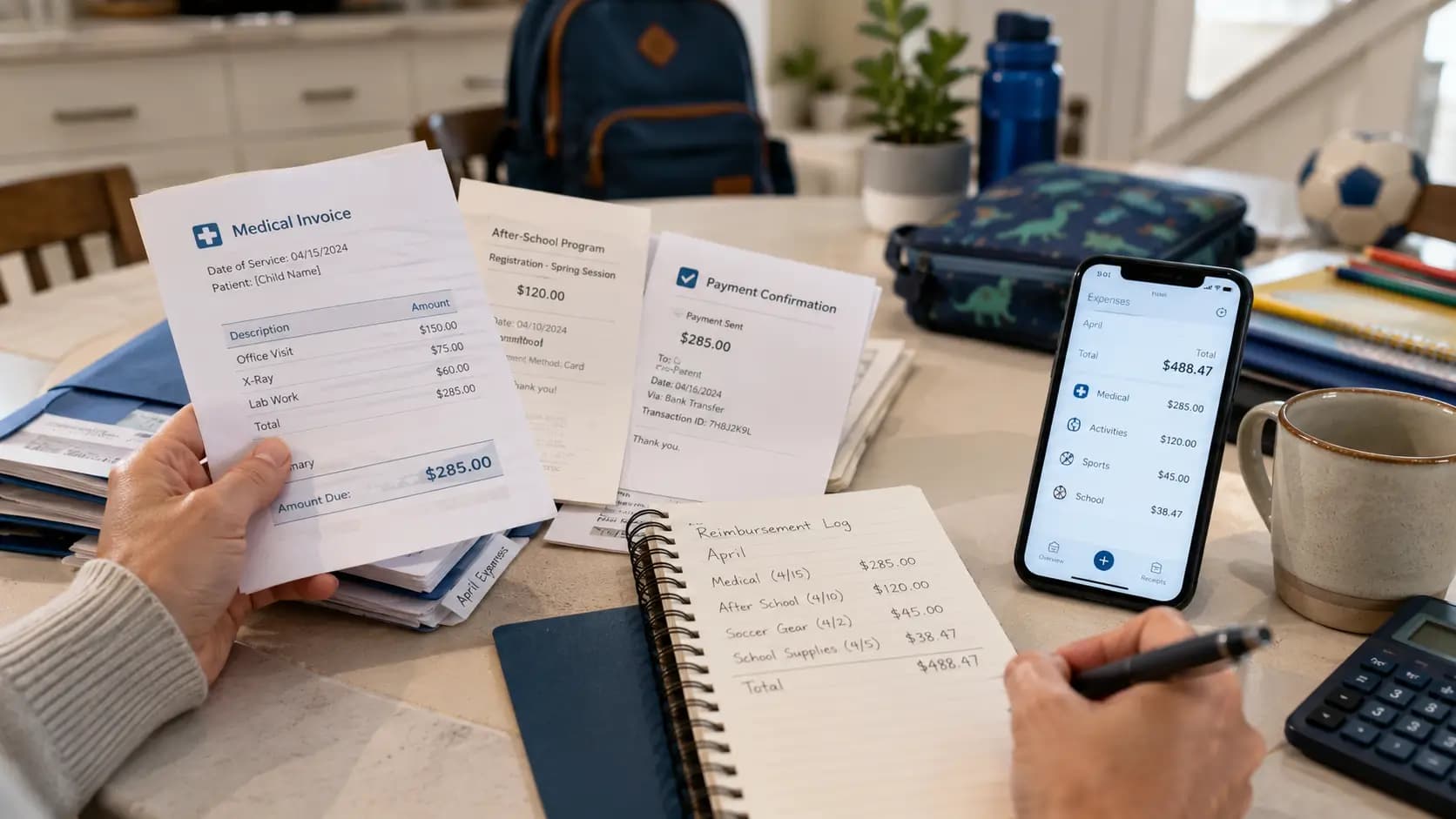
- Save the itemized invoice, receipt, Explanation of Benefits, and payment confirmation.
- Calculate the net reimbursable amount after discounts, insurance, refunds, or credits.
- Send a factual reimbursement request with the documents and the due date.
- Record the response, payment date, amount paid, and remaining balance.
Written approval is especially important for optional or high-cost expenses. Save the complete email or message thread, not only a cropped screenshot. Our guide on saving text messages for family court explains how to preserve the original context.
Why do reimbursement deadlines vary by state?
There is no single national deadline. The order may set its own notice and payment periods, and state rules differ.
- California example: Family Code section 4063 generally requires an itemized statement within a reasonable time, no more than 90 days after the cost accrues. If the court order does not specify a payment period, the reimbursing parent generally has no more than 30 days after receiving notice to pay.
- New York example: certain childcare and unreimbursed healthcare costs may be allocated in proportion to parental income and separately stated in the order.
- Illinois example: courts may add reasonable school, extracurricular, and childcare expenses beyond the basic support obligation, with childcare generally prorated according to the parents’ shares of combined net income.
- Texas example: medical and dental support are additional forms of child support, while extracurricular payment and approval terms may require specific language in the order.
These are examples, not rules for every case. Use your current order first, then check the law and court guidance for the state that controls the case.
What records should you keep for every expense?
A reimbursement request is easier to review when it shows both what was charged and what was actually paid. For broader documentation guidance, see how to document child expenses after divorce.
- itemized receipt, invoice, medical statement, or school statement;
- Explanation of Benefits showing the insurance portion and patient responsibility;
- bank, card, check, transfer, or online payment confirmation;
- written approval when the order requires agreement;
- the reimbursement request with the date sent;
- the other parent’s response, or the dated request and follow-up history if no response was received;
- proof of full payment, partial payment, refund, credit, or insurance reimbursement;
- a short factual note explaining anything the documents do not show.
A receipt or invoice can help show what was purchased or charged. A bank, card, check, or transfer record can help show that payment was made. The clearest record links both types of proof to the same dated expense entry.
What should a shared child expense tracker contain?
Use fields that answer the questions another person will ask later. Keep the wording short and factual.
- Date: when the cost was incurred and when it was paid.
- Child: which child benefited from the expense.
- Category: medical, childcare, school, activity, transport, or another stable label.
- Total and net amount: the original charge and the amount left after insurance, refunds, or discounts.
- Parent who paid: who fronted the cost.
- Other parent’s share: amount calculated under the order.
- Approval: required, obtained, not required, or disputed.
- Request and due dates: when reimbursement was requested and when it should be paid.
- Status: requested, partially paid, paid, disputed, or overdue.
- Supporting file: receipt, invoice, EOB, payment proof, email, or message.
- Reimbursement basis: the paragraph, provision, or written agreement supporting the request.
In documentation, chronology matters more than memory. A record should let the reader move from the expense entry to the source document and the reimbursement history without searching through several apps.
What does a clear expense record look like?
| Date | Child | Expense | Net amount | Other parent’s share | Reimbursement status | Proof |
|---|---|---|---|---|---|---|
| Mar. 8, 2026 | Maya | Orthodontic payment | $240 | $120 at 50% | Paid | Invoice, EOB, card confirmation |
| Mar. 15, 2026 | Maya | Spring soccer registration | $180 | $72 at 40% | Requested | Registration receipt, approval email |
| Mar. 22, 2026 | Ethan | After-school care for March | $420 | $252 at 60% | Partially paid | Provider invoice, bank transfer |
The table does not decide whether an expense is legally reimbursable. It simply shows the calculation, supporting documents, and payment history clearly.
As the record grows, loose receipts and spreadsheets become harder to maintain. DivKids lets a parent record each expense, assign it to a child, attach receipt photos, add a short reimbursement note, and keep a private dated history in one place. Create a free DivKids account.
How should you request reimbursement?
Keep the message factual. State the expense, why it falls under the order, the net amount, the calculation, the documents attached, and the payment deadline. Avoid arguing about the other parent’s motives or combining several old disputes in the same message.
- Child and expense: Maya orthodontic payment dated March 8.
- Order reference: uninsured medical expenses, paragraph 9.
- Net out-of-pocket amount: $240 after insurance.
- Share requested: $120 under the 50/50 allocation.
- Documents: invoice, EOB, and card payment confirmation.
- Due date: the date required by the order or applicable rule.
Use a payment method that creates a clear record. If cash is unavoidable, ask for a dated receipt or written confirmation showing the amount and purpose.
How should you handle difficult expense situations?
One receipt covers several children
Create separate entries for each child when the amounts can be identified. If the cost cannot be divided precisely, explain the method instead of silently assigning the full receipt to one child.
The receipt includes household and child items
Mark the child-specific line items and calculate only those amounts. A full grocery or department-store total without explanation is difficult to review.
The purchase was made online
Keep the order confirmation, itemized invoice, shipping or service confirmation, and payment record. Do not rely only on a screenshot that omits the item or final amount.
The receipt is missing
Add a dated note promptly and attach the strongest available substitute, such as a bank transaction, provider message, appointment confirmation, or duplicate invoice. Be clear that the original receipt is unavailable.
There was a refund or insurance reimbursement
Update the entry to show the gross charge, the amount returned, and the final out-of-pocket cost. Recalculate the other parent’s share from the net amount unless the order says otherwise.
The other parent paid only part
Record the amount requested, amount received, payment date, and remaining balance. Do not replace the original figure with the partial payment.
What should you do with unpaid or disputed reimbursements?
First check whether the request followed the order: covered category, approval, provider rules, calculation, documentation, notice deadline, and payment deadline. A dispute may concern the expense itself, the percentage, the proof, or whether approval was required.
- Send one clear follow-up that identifies the original request and current balance.
- Keep the response factual and preserve the complete communication.
- Do not unilaterally withhold regular child support or deny parenting time in response to an unpaid expense. These obligations are generally treated separately, and state-specific advice may be needed.
- If the order is unclear, seek state-specific legal advice or ask about clarification or modification.
- Before filing anything, confirm the local enforcement process, required forms, and evidence rules.
A private record is useful even when reimbursement requests are sent through a shared co-parenting platform. The shared tool may show the request, while your private file keeps the complete receipt, payment proof, notes, and history. See what co-parenting apps are good for and what should stay private.
What mistakes create the most confusion?
- Treating every child-related purchase as an automatic reimbursable add-on.
- Requesting repayment without reading the controlling order or agreement.
- Skipping required advance approval for optional or high-cost expenses.
- Sending one cropped screenshot without the invoice, payment proof, or context.
- Mixing regular child support, direct purchases, reimbursements, and informal offsets in one total.
- Waiting several months before sending receipts or requests while documents remain scattered across email, photos, banking apps, spreadsheets, and paper folders.
How can you manage this in practice?
- Read the order once and summarize the rules. Note covered categories, split percentages, approval requirements, deadlines, and payment methods.
- Create one standard expense entry. Use the same fields and categories every time.
- Save proof immediately. Attach the receipt, invoice, EOB, payment confirmation, and approval before they disappear into other apps.
- Send requests on a regular schedule. Weekly or monthly can work, but never let your routine override a shorter legal deadline.
- Review the history once a month. Check for missing proof, partial payments, refunds, disputes, and overdue balances.
If you prefer a spreadsheet, use it as a summary and keep every source file behind it. Our guide on using Excel to track child expenses explains where spreadsheets help and where they become difficult.
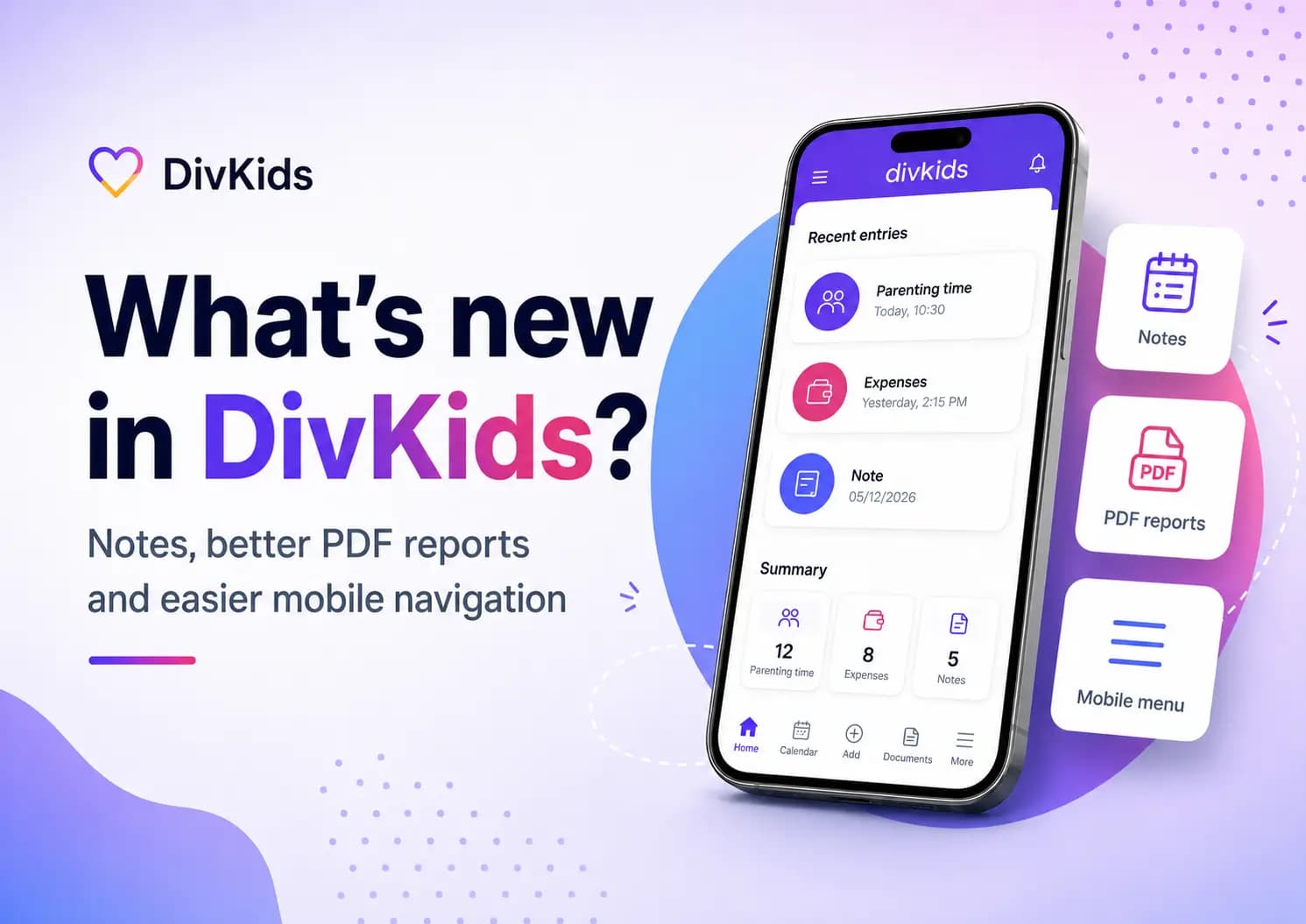
DivKids can reduce the organizational work by keeping expenses, receipt photos, child assignment, notes, parenting-time entries, and PDF reports together in one private account. It does not decide whether a cost is reimbursable, guarantee payment, or replace advice from a qualified attorney.
Which state sources explain these differences?
Use current state statutes, court guidance, and reputable statewide legal-aid resources when checking terminology, categories, percentages, and deadlines. The following examples show why nationwide guidance must remain cautious:
- California Family Code section 4063 explains itemized reimbursement requests, proof of payment, and timing for certain additional child support costs.
- New York Domestic Relations Law section 240 addresses basic support and pro rata childcare, health insurance, unreimbursed healthcare, and some educational expenses.
- Illinois section 750 ILCS 5/505 addresses basic support and additional school, extracurricular, and childcare expenses.
- Texas Family Code Chapter 154 addresses child support, medical support, and dental support.
- TexasLawHelp extracurricular guidance explains why optional activity provisions may need customized order language.
Key takeaways
- Treat a child expense as separately reimbursable only when the order, agreement, written approval, or applicable law supports the request.
- Keep regular child support separate from additional expenses and reimbursements.
- Use the formula: net out-of-pocket amount x ordered percentage = requested share.
- Record the date, child, category, payer, approval, share, due date, status, proof, and reimbursement basis.
- Save the invoice or receipt and proof that the payment was actually made.
- Track refunds, insurance payments, partial reimbursements, disputes, and overdue balances without deleting the original entry.
- If you want to organize expenses as they happen and keep a clear PDF-ready history, you can start with a free DivKids account.
Frequently Asked Questions
What is the difference between child support and shared child expenses?
Which child expenses are usually shared after divorce?
How do I request reimbursement from a co-parent?
What proof should I keep for a child expense reimbursement?
What if the other parent does not reimburse a shared child expense?
Can I use a spreadsheet to track child expense reimbursements?