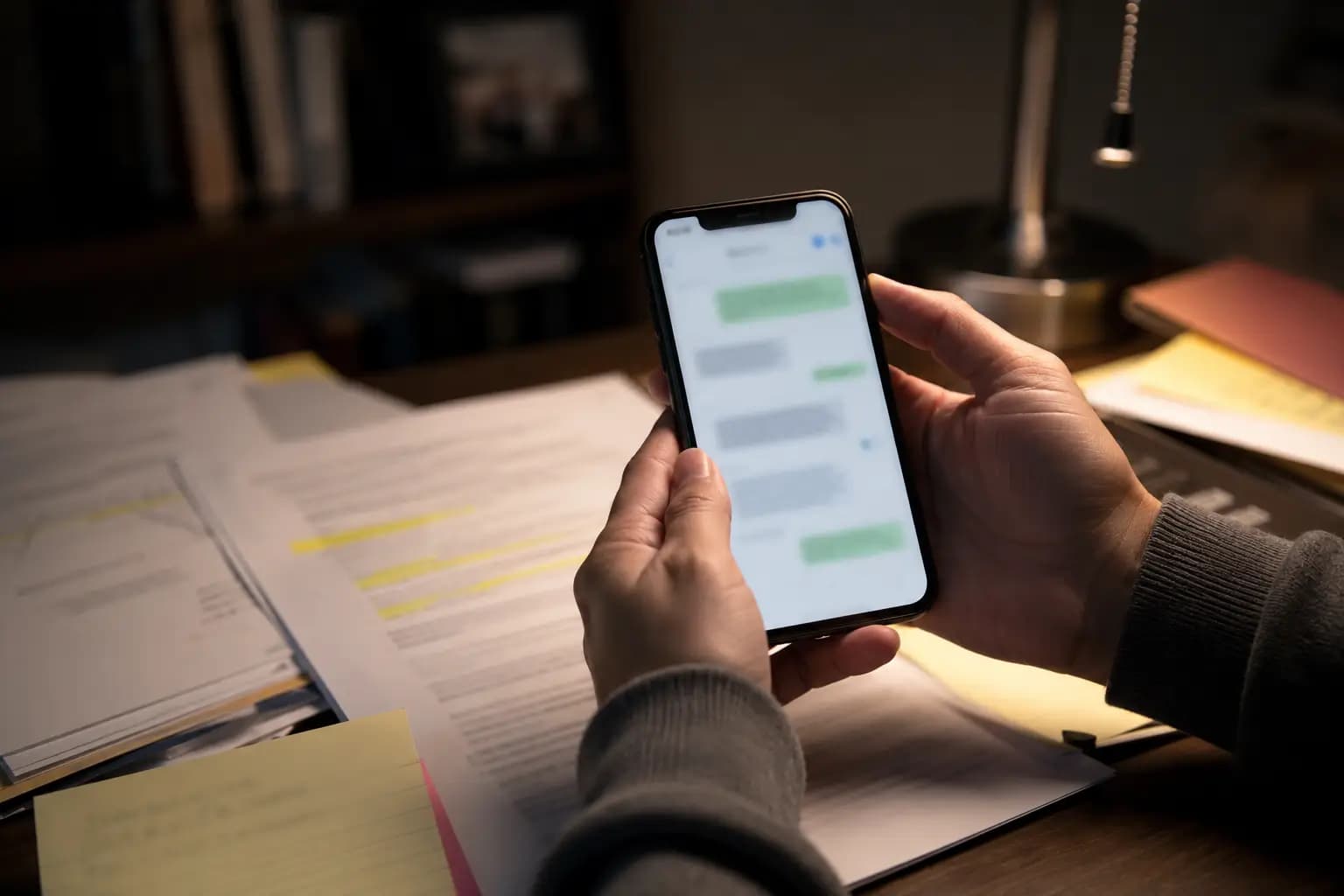
Text messages can be used in many US family-court cases, but a screenshot is not automatically admissible just because it appears on your phone. The court may still ask whether the conversation is relevant, who actually sent the messages, whether the thread is complete, whether the statements are hearsay, and whether you followed local rules for filing and serving exhibits.
This article provides general information for parents in the United States and is not legal advice. Evidence rules and family-court procedures vary by state, county, court, judge, and type of hearing.
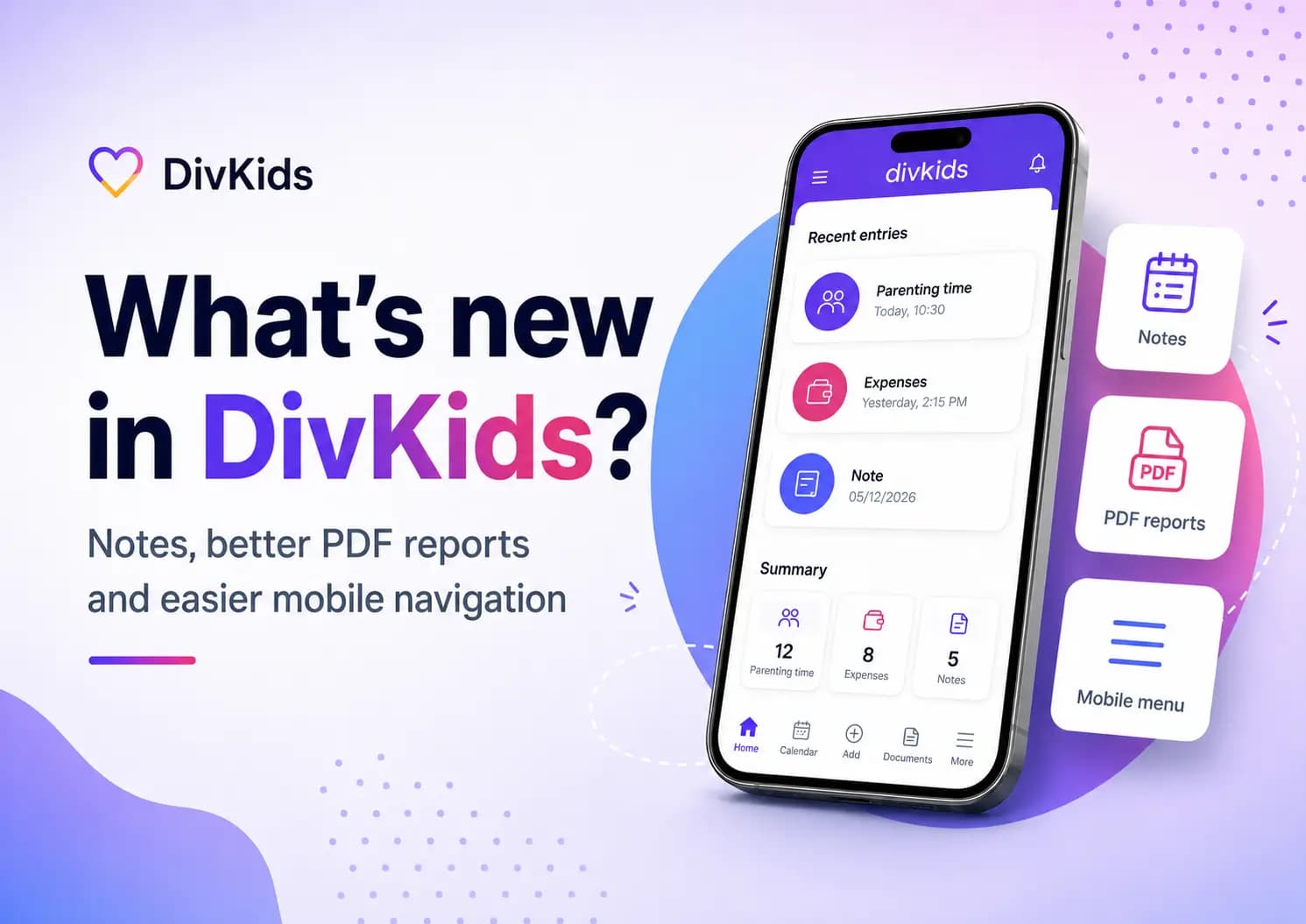
Messages are usually easier to understand when they are connected to a dated timeline. See our guide on how to keep a custody journal for court. You can also review how DivKids Notes and PDF reports help keep screenshots and factual notes together.
This guide uses the Federal Rules of Evidence as a general framework for authentication, hearsay, completeness, and electronic records. Most custody and divorce cases are handled in state courts, so the rules that control your case may be different.
TL;DR
Save the full conversation, keep the original messages on the device or account, capture the sender information and dates, avoid editing or misleading crops, create a readable working copy, and check the court’s exhibit deadlines. Text messages may be useful evidence, but the judge can still exclude or give little weight to a thread that is incomplete, unauthenticated, irrelevant, or presented incorrectly.
Quick answer
Are text messages admissible in family court? Often they can be, but not automatically. A parent usually needs to show that the messages are connected to an issue in the case, that the conversation is what the parent claims it is, and that the messages are being offered for a legally permitted purpose.
- Preserve first: keep the original thread before making screenshots, printouts, or summaries.
- Show context: save the conversation before and after the key message.
- Identify the sender: preserve the phone number, account, profile, dates, and surrounding details.
- Prepare for court: follow local rules on filing, service, copies, redaction, and digital exhibits.
Key points
- A contact name displayed on a screenshot does not by itself prove who typed the message.
- Full conversations are generally safer than isolated screenshots.
- Keep an untouched original and make a separate copy for highlighting or annotation.
- Record when and how the messages were saved.
- Do not delete unfavorable messages from the same conversation.
- Do not access the other parent’s private account without permission.
- A clean PDF can improve readability, but it does not replace the original thread.
- Ask about exhibit deadlines before the hearing, not on the morning of court.
Table of contents
- TL;DR
- Quick answer
- Key points
- Can text messages be used in family court?
- What evidence hurdles apply?
- How to save text messages properly
- Screenshots, exports, or the original phone?
- How to organize messages for court
- What about WhatsApp, iMessage, and Messenger?
- Common mistakes
- Example message evidence log
- Privacy and safety
- A practical DivKids workflow
- Official sources
- Key takeaways
Can text messages be used in family court?
Text messages may be relevant in disputes about parenting time, schedule changes, agreements, threats, harassment, child-related decisions, expenses, or whether a parent received notice. California’s court self-help guidance expressly lists text messages and emails among the types of evidence a person may gather for a restraining-order hearing.
That does not mean every text will be accepted. Courts distinguish between possessing a screenshot and successfully offering it as evidence. The message still has to satisfy the rules that apply to the hearing, and the other parent can challenge its source, meaning, completeness, or reliability.
The purpose for which a message is offered also matters. A statement offered to prove that its words are true may raise a hearsay issue. A message offered to show notice, a request, a threat, the effect on the recipient, or the fact that communication occurred may involve a different analysis. A family-law attorney can identify the correct purpose and any state-specific exception.
What evidence hurdles apply?
The Federal Rules of Evidence are not the controlling rules in most state family-court cases, but they provide a useful framework for understanding common objections.
| Issue | What it means in practice | How better preservation helps |
|---|---|---|
| Relevance | The message should relate to an issue the court must decide. | Connect the thread to a date, event, order, request, or disputed fact. |
| Authentication | You may need to show that the conversation and sender are what you claim. | Keep the number or account, surrounding messages, dates, and the original device or account. |
| Hearsay | The court may ask why an out-of-court statement is being offered. | Preserve the exact words and let a lawyer assess the purpose and any exception. |
| Completeness | The other side may argue that an isolated screenshot changes the meaning. | Save the full relevant conversation before selecting key pages. |
| Original or duplicate | A printout or copy may be accepted, but authenticity can still be challenged. | Keep the source thread and an untouched backup in addition to the court copy. |
| Procedure | Even useful evidence may be rejected if it was filed or served too late. | Check the local exhibit order, deadlines, required copies, and upload system. |
Federal Rule 901 describes authentication through testimony from a person with knowledge, distinctive characteristics in the item, and evidence about an accurate process or system. In practical terms, the sender’s known number, references to facts only that person would know, the flow of the conversation, and later conduct may help, while a contact name alone may be weak.
Federal Rules 1001 through 1003 also recognize electronic information, accurate printouts, and duplicates. This does not create a universal right to admit any screenshot. It explains why preserving the original source and showing that a copy accurately reflects it can matter.
How to save text messages properly
- Stop deleting. Preserve the entire relevant conversation, including messages that do not help your position.
- Keep the original source. Leave the thread on the phone, messaging account, or backed-up device when possible.
- Capture identity information. Save the phone number, account name, profile details, and enough context to explain who participated.
- Capture dates and times. Make sure the screenshots or export show when each important message was sent or received.
- Save the surrounding conversation. Include enough messages before and after the key statement to prevent a misleading impression.
- Create an untouched backup. Store a copy securely before cropping, highlighting, adding notes, or converting files.
- Create a readable working copy. Arrange the pages in chronological order and add page numbers or item numbers without changing the original text.
- Write a preservation note. Record the date, device, application, method used, and whether media or attachments were included.
Do not rely only on a single image saved in the phone gallery. A screenshot may omit the number, date, earlier context, attachments, reactions, or later corrections. It may also be difficult to explain months later if you cannot locate the original conversation.
Screenshots, exports, or the original phone?
| Method | Strength | Limitation |
|---|---|---|
| Screenshots | Quick, visual, and easy to connect to a specific statement. | Can omit context, sender details, timestamps, or hidden parts of the thread. |
| Chat export or device backup | May preserve a longer chronological record and attachments. | Format and available data vary by device and application. |
| Printed PDF | Easier for a judge, lawyer, or mediator to review and page-reference. | It is a presentation copy, not a substitute for the source record. |
| Original phone or account | Can help demonstrate where the conversation came from. | The judge may not view evidence directly on a phone, and court access may be restricted. |
The North Carolina Judicial Branch advises court users to print evidence stored on a phone, including text messages and emails, because the judge may not be able to view the phone. It also advises bringing copies for the judge, the other party, and yourself.
The safest approach is usually layered: preserve the original thread, keep a secure backup, prepare a complete export when available, and create a readable court copy that points back to the original.
How to organize text messages for court
Do not hand a lawyer or judge hundreds of random screenshots with no explanation. Create a simple index that identifies the issue, date range, participants, and supporting pages.
- Use a clear item number, such as MSG-001.
- State the date range and messaging platform.
- Identify the participants by name and number or account.
- Add one neutral sentence explaining why the thread matters.
- List the pages containing the key part of the conversation.
- Keep the complete thread available even if the working set uses selected pages.
California’s family-court guidance explains that documents usually need to be filed and provided to the other side before the hearing. The court may decline to consider late material. Minnesota also uses a digital exhibit system for many evidentiary hearings and trials. Your own court may require paper, electronic upload, an exhibit list, or a particular file format.
Before filing, remove or redact information the court does not need, such as full financial account numbers, sensitive medical details, home addresses protected by an order, or unrelated information about children.
What about WhatsApp, iMessage, and Messenger?
The same basic evidence principles apply to SMS, iMessage, WhatsApp, Messenger, Signal, email, and other communication platforms: preserve the source, identify the participants, save the context, and avoid silent edits.
Application features can create additional problems. Disappearing messages may remove content. A username can change. Reactions, edited-message labels, deleted-message notices, voice notes, images, and group participants may be important to the meaning of the conversation.
For WhatsApp or another chat application, preserve both a visual copy and any available export or backup. Save linked media separately and note which message it belongs to. Do not assume that an export contains every piece of account or device information needed to prove authorship.
When messages came from a group chat, record who was in the group during the relevant period. When a screenshot was forwarded to you by someone else, preserve the forwarding message and consider whether the original participant or device may be needed to authenticate it.
Common mistakes that weaken message evidence
- Showing only one damaging sentence. The omitted conversation may change its meaning.
- Saving the contact name but not the number. A person can rename a contact on their own phone.
- Editing the only copy. Highlighting, cropping, or annotating should be done on a duplicate.
- Deleting your own messages. An incomplete thread can damage credibility and may create legal problems.
- Combining different conversations. Do not make one image appear to be a continuous exchange when it is not.
- Waiting until the hearing. Filing and service deadlines may apply weeks earlier.
- Relying only on the phone. The judge may not be able or willing to inspect it during the hearing.
- Including irrelevant private material. More pages do not automatically make the evidence stronger.
The same principle applies to other digital proof. Our guide on photo receipts in family court explains why the source record, context, and organization matter more than simply having an image.
Example message evidence log
The examples below are fictional and show organization only. They do not predict whether a court would admit a particular message.
| Item | Neutral description | Files preserved |
|---|---|---|
| MSG-001 | Text thread from March 3-4, 2025 concerning a request to move Friday pickup from 5:00 p.m. to 7:00 p.m. | Full screenshots, PDF working copy, device backup, calendar entry. |
| MSG-002 | WhatsApp conversation from April 11, 2025 in which both parents confirmed that the child would attend a medical appointment. | Chat export, screenshots showing participants and dates, appointment confirmation. |
| MSG-003 | Messages from May 6, 2025 concerning cancellation of parenting time and the proposal of replacement time. | Complete thread, custody-journal entry, parenting-time calendar. |
A neutral description is better than a conclusion such as „proof that the other parent lies.” Let the messages and surrounding evidence show what happened.
Privacy and safety
Preserve only information you obtained lawfully. Do not guess passwords, access the other parent’s private account, install monitoring software, impersonate another person, or pressure a child to obtain messages.
Secret recordings are a separate issue from text messages and may be governed by state wiretap or consent laws. Do not assume that because you can record a call, it is lawful to do so.
If messages contain threats, stalking, abuse, possible abduction, or an immediate safety risk, do not delay action merely to create a better evidence file. Contact emergency services or an appropriate local professional and obtain case-specific legal advice.
If litigation has started or is reasonably expected, ask a lawyer before deleting messages, replacing a phone, closing an account, or changing automatic-deletion settings. Preservation obligations and possible consequences vary by jurisdiction.
A practical DivKids workflow
DivKids can help keep an important screenshot connected to the date and event it relates to. The goal is not to replace the original conversation. The goal is to stop relevant records from becoming lost among thousands of photos and unrelated chats.
- Preserve the full original conversation on the device or account.
- Create a dated Note describing the event in neutral language.
- Add the key screenshot or document as an attachment.
- Use the same reference number in the Note and your complete-message folder.
- Connect the message to the relevant parenting-time or expense record.
- Export a report for review while keeping the original messages available.
For wider context, read how to keep a custody journal that holds up in court. A journal explains the event, while the original message thread supports the communication behind it.
Official sources
- United States Courts – Federal Rules of Evidence
- California Courts – Submit documents for a family-law hearing
- California Courts – Prepare evidence for a restraining-order hearing
- North Carolina Judicial Branch – Going to Court Basic Information
- Minnesota Judicial Branch – Evidence and Exhibits
- Massachusetts Guide to Evidence – Digital Evidence
These sources illustrate general evidence concepts and different court procedures. They do not replace the state rules, local orders, deadlines, or legal advice that apply to your case.
Key takeaways
- Text messages may be admitted in family court, but screenshots are not automatically evidence.
- Preserve the original source, full context, participants, dates, attachments, and an untouched backup.
- Use a separate working copy for page numbers, highlighting, and court preparation.
- Authentication, hearsay, completeness, relevance, and local procedure can all affect whether a judge considers the messages.
- Printouts and PDFs improve readability but should remain traceable to the original conversation.
- File and serve exhibits by the deadline required by your court.
- Do not obtain messages unlawfully or delete relevant material once a dispute may lead to litigation.
- To organize screenshots, dated notes, parenting time, and supporting records in one private account, create a DivKids account.
Frequently Asked Questions
Are text messages admissible in family court?
Are screenshots enough to prove text messages?
How should I save text messages for a custody case?
Can WhatsApp messages be used in a custody case?
Can I show the judge messages directly on my phone?
Should I delete irrelevant or embarrassing messages?