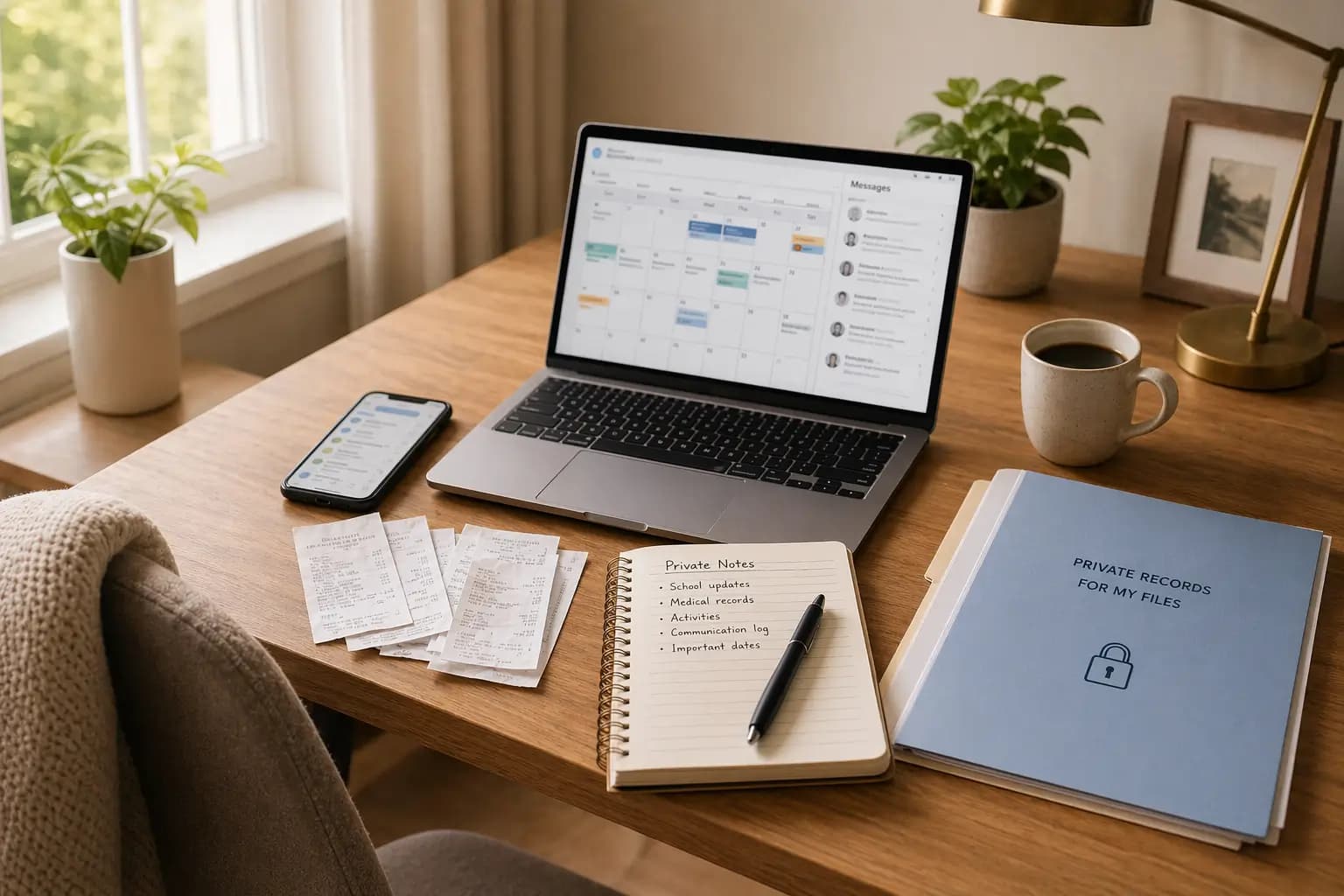
You spent $9,000 on your kids last year. Your ex claims it was maybe $3,000. In court, without proof, your word means nothing.
The parent who walks in with organized records—receipts, dates, categories, totals—gets believed. The parent who relies on memory loses credibility fast. According to family law professionals, clear financial documentation often settles custody disputes before trial, saving families thousands in legal fees and months of stress.
This guide shows you how to turn everyday purchases into court-ready evidence using the DivKids application. You’ll capture photo receipts immediately, categorize each expense consistently, assign entries to the right child, and export clean PDF reports you control. No shared accounts. No real-time debates. Just facts, ready when you need them.
What you’ll learn:
- What family courts accept as proof
- How to build a reliable evidence trail
- Photo receipts that pass scrutiny
- Organizing by category and child (with real examples)
- When you have no receipt or paid cash
- Assembling your court-ready PDF report
- Case study: How James documented $9,200 and settled his case
- Helpful legal resources
- Why your records should stay private
What family courts accept as proof
Judges and mediators want verifiable facts, not estimates. They look for evidence they can quickly review and trust.
Accepted evidence types:
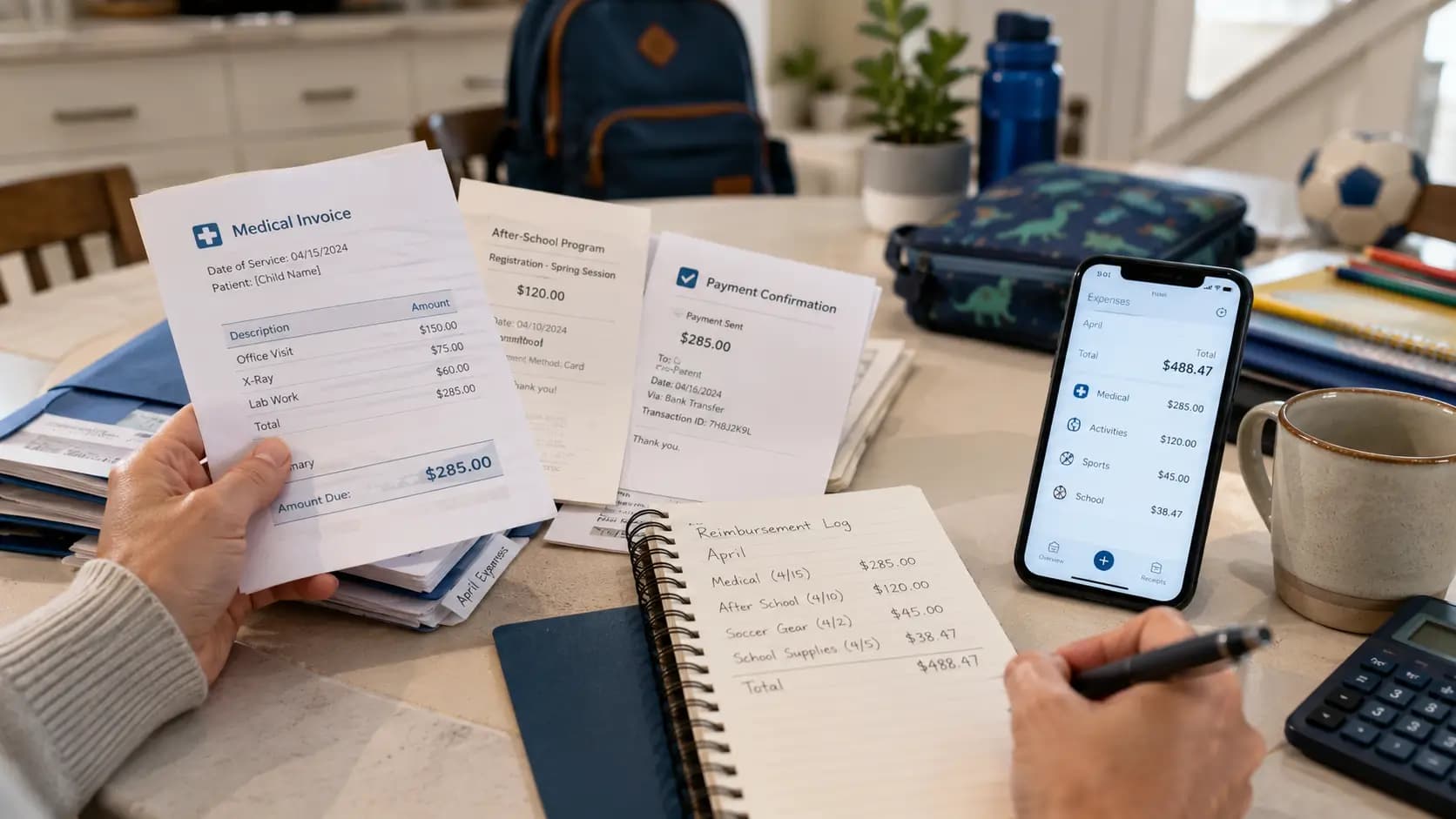
Receipts and invoices. Show vendor name, date, items purchased, and total amount. Examples: school supplies $85, pediatric copay $30, soccer registration $180.
Service confirmations. Appointment cards, booking emails, online payment confirmations from clinics, schools, or activity providers.
Bank or card records. Used as supporting context for documented purchases. A bank statement alone isn’t enough—you need to connect it to what you bought and why.
Short factual notes. Brief descriptions that explain the child-related purpose: „Sarah—winter coat”, „Jake—orthodontist consultation.”
Procedure varies by jurisdiction. For practical guidance, see how to submit documents for family law hearings (California Courts) or review Family Procedure Rules (UK Courts). The principle is universal: submit evidence early, organize it clearly, stay consistent.
How to build a reliable evidence trail
Good documentation comes from one simple habit: log immediately and do it the same way every time.
In DivKids, each expense entry captures:
- Amount
- Date
- Category
- Assigned child
- Short note (3-6 words)
- Photo of the receipt
Repeat this after every purchase. Over weeks and months, you build a timeline that’s hard to dispute.
Your process:
Step 1: Right after purchase, open DivKids and add the entry.
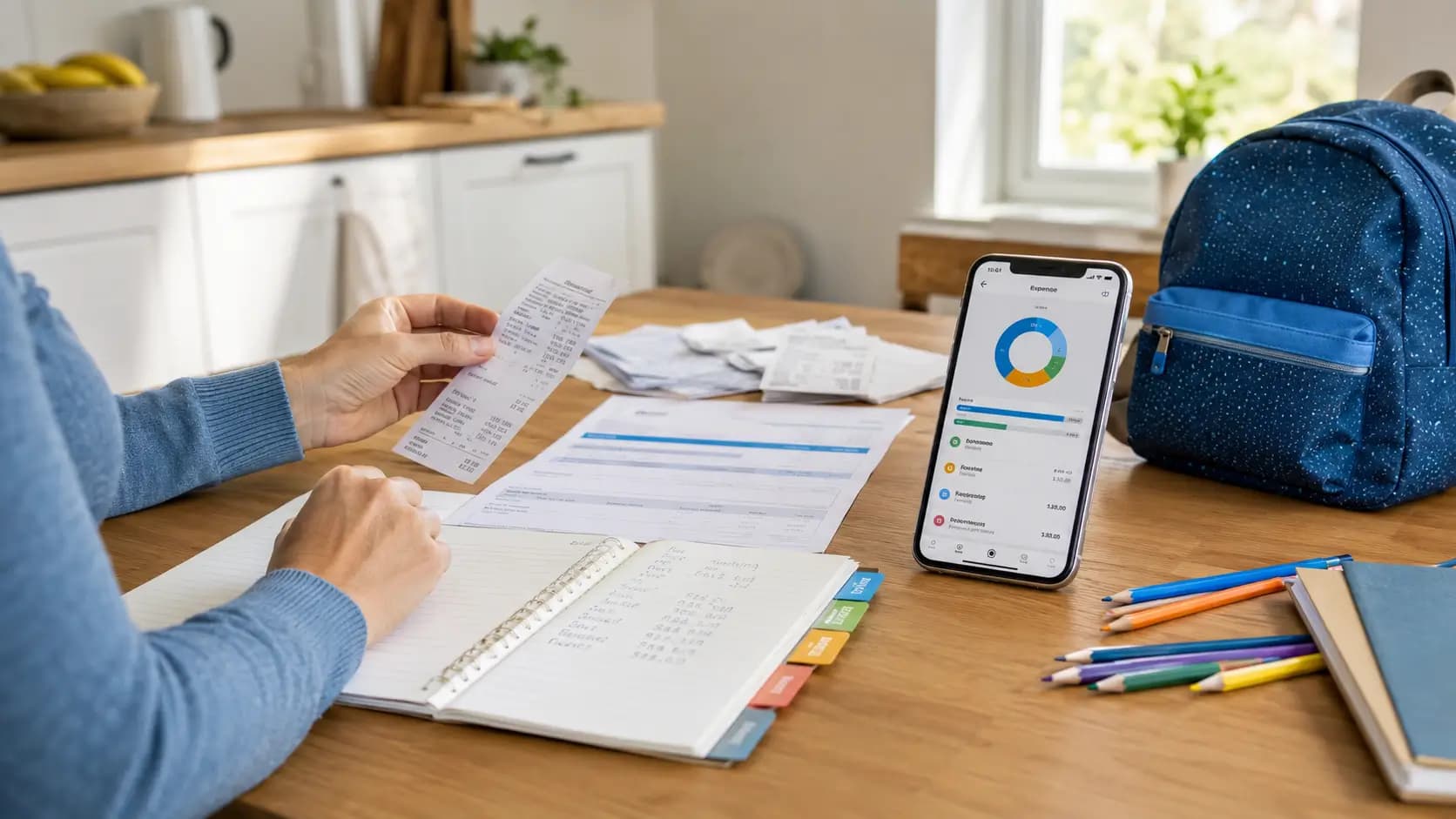
Step 2: Take a clear photo of the receipt. Add it to the entry.
Step 3: Write a brief note. Example: „Sarah—school shoes” or „Jake—therapy copay.”
Step 4: Assign the category (Medical, School, Activities, etc.) and child.
Step 5: At the end of each month, review for typos and missing photos.
Takes two minutes per expense. Over six months, you have 100+ documented entries with proof. That’s credibility.
Photo receipts that pass scrutiny
Not all receipt photos are equal. Blurry or partial images get questioned immediately.
How to photograph receipts properly:
Capture the whole receipt. Include vendor name, date, all line items, and total. If the receipt is long, take two photos.
Use good lighting. Natural daylight or a bright desk lamp. Avoid shadows across the text.
Lay it flat. Place the receipt on a table rather than holding it mid-air. Shoot from directly above.
Add the entry immediately. Don’t wait three days. Memory fades. Details blur. Do it right after purchase while everything is fresh.
Keep the paper copy. Digital is convenient, but having the original as backup never hurts. Toss receipts in a labeled envelope by month.
Examples of expenses that consistently work in court:
Medical: Pediatric visit copay $30, pharmacy prescription $26, therapist invoice $95, dental cleaning $75.
School: Backpack and supplies $85, lab fee $40, class photos $28, textbooks $62.
Activities: Soccer league registration $180, cleats and shin guards $65, piano lesson $40, swim team dues $95.
Clothing: Winter coat $72, PE sneakers $54, school uniform shirts $45.
Childcare: After-school program $320/month, occasional babysitter $80, summer camp deposit $400.
Organizing by category and child (with real examples)
A list of expenses without organization is useless in court. Categories and child assignments turn chaos into clarity.
Use stable categories: Medical, Education, Childcare, Activities, Clothing, Transportation, Food during custody time. Don’t change category names month to month. Consistency makes your totals comparable.
Assign every expense to a child. If you have two kids, this is critical. Courts need to know which expenses benefited which child, especially for support calculations.
Example: Six-month expense breakdown for one child
- Medical: $780 (11 entries with receipts—doctor visits, prescriptions, dental)
- Education: $1,420 (school supplies, fees, class materials, field trips)
- Childcare: $1,920 (after-school program 6 months, occasional sitter)
- Activities: $860 (soccer registration, equipment, music lessons)
- Clothing: $640 (seasonal purchases, school uniforms)
- Transportation: $210 (bus passes, parking for school events)
Total: $5,830 in six months. Clear categories. Every entry tied to the child. Every expense backed by a receipt photo.
In DivKids, filters let you export exactly what you need. Medical expenses only for Sarah? January through June? Both children, all categories? You control what goes into each report.
When you have no receipt or paid cash
Lost a receipt? Paid cash at a school event? Don’t skip the entry.
Create the entry anyway: Add date, exact amount, category, and a neutral note. Example: „Cash—school lunch card reload $40.”
Add context if possible: Take a photo of the item, the provider’s sign, or an appointment card. Anything that shows the expense was real.
Attach any confirmation: Text from the provider, booking email, bank withdrawal tied to the date and location.
Be consistent: If you document cash expenses the same way every time, reviewers see a steady practice, not last-minute guesses.
One missing receipt isn’t fatal. Ten expenses with no proof? That’s a credibility problem. Document what you can, every time.
Assembling your court-ready PDF report
All the tracking in the world doesn’t matter if you can’t present it clearly.
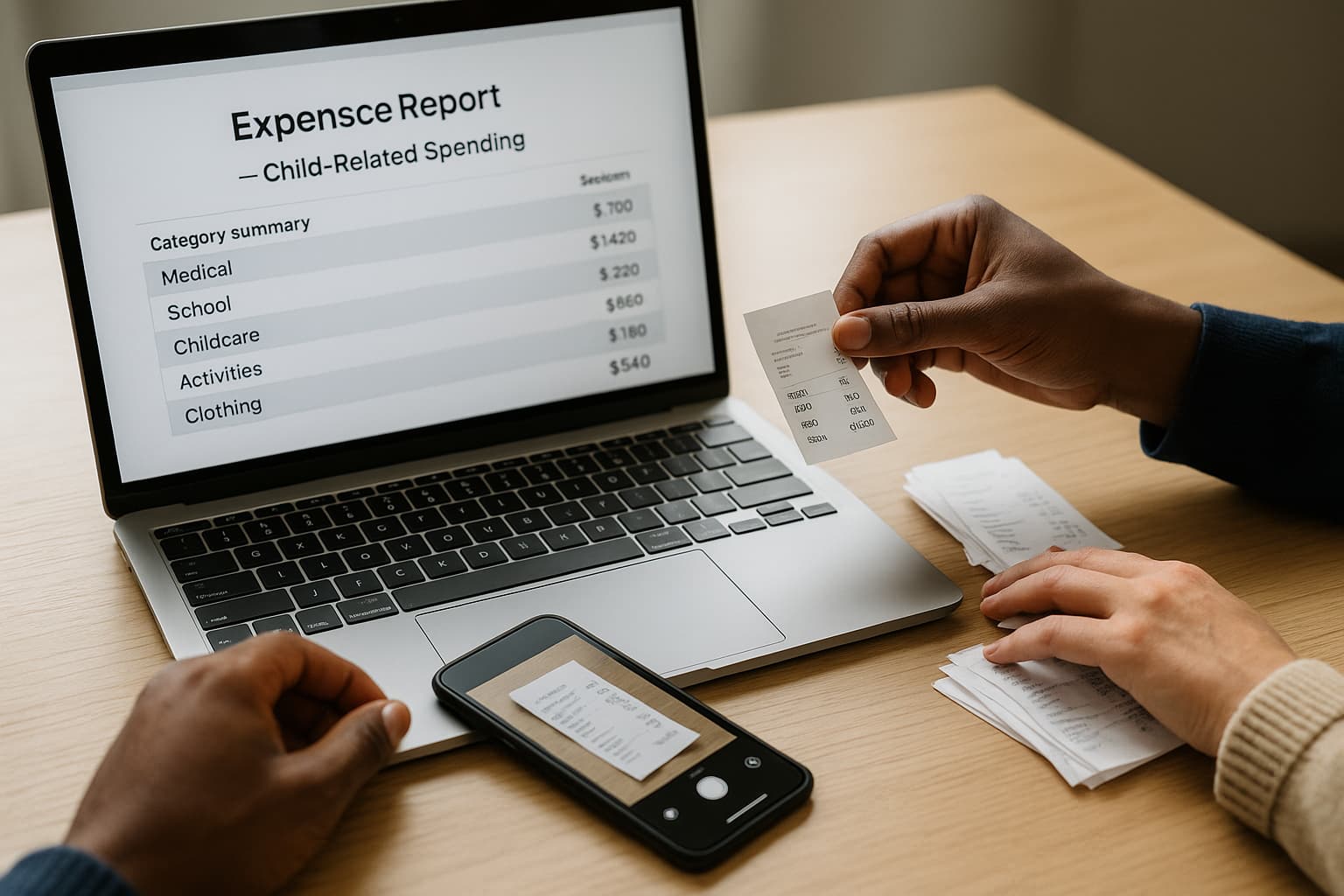
In DivKids, you choose your date range, select which child and categories to include, then download a polished PDF in seconds.
What a strong report contains:
Header with summary: „Child Expenses Report: January 1 – June 30, 2024. Child: Sarah Martinez. Total: $5,830.”
Category breakdown upfront: Table showing Medical $780, Education $1,420, Childcare $1,920, Activities $860, Clothing $640, Transportation $210. Totals at a glance.
Itemized list: Each expense with date, description, amount, brief note, and indicator that receipt photo is attached.
Clean, professional layout: Not screenshots. Not handwritten notes. A formatted document that looks organized and credible.
Share the PDF with your attorney. Bring it to mediation. Submit it according to your court’s procedure. You control the disclosure—nothing more, nothing less.
Case study: How James documented $9,200 and settled his case
James is a divorced father of two, ages 8 and 11.
His ex filed a motion claiming James „barely contributed financially” and demanding he pay significantly higher child support. James knew that wasn’t true—but could he prove it?
For eight months, he’d been logging every child-related purchase in DivKids. Every receipt photographed. Every expense categorized. Every entry assigned to the right child.
When his attorney asked for documentation, James exported a PDF covering those eight months.
Total documented: $9,200 across 186 transactions.
Breakdown:
Medical: $1,120—Pediatric visits ($30 copays), prescriptions ($26-$32 each), therapy sessions ($95 each), dental cleaning ($75).
Education: $2,380—School supplies ($85 twice), registration fees ($45-$120), textbooks ($62), class projects ($40-$60).
Childcare: $2,240—After-school program ($320/month for 7 months), occasional babysitter when working late ($80, $95).
Activities: $1,360—Soccer league registration ($180), cleats and equipment ($65), weekly piano lessons ($40 × 16 weeks), swim team dues ($95).
Clothing: $1,000—Seasonal shoes, coats, school uniforms spread across eight months.
Transportation: $1,100—Gas for custody exchanges and school runs, parking for sports events.
His lawyer presented the report in mediation. The opposing attorney reviewed it—organized entries, receipt photos for nearly every transaction, clear category totals. The claim that James „barely contributed” fell apart immediately.
Rather than push to trial, they settled. James’s support obligation was adjusted fairly based on actual documented contributions. The case closed without courtroom drama.
Cost of tracking in DivKids for eight months: Minimal. Legal fees saved by settling before trial: An estimated $10,000-$15,000. More importantly, James kept his credibility intact and maintained his relationship with his kids without a bitter battle.
Helpful legal resources
How to submit evidence for family law hearings (California Courts)—Practical steps on filing and serving documents.
Family Procedure Rules (England & Wales)—Official rules outlining how family cases are managed.
Check your local court’s website for jurisdiction-specific requirements. Rules differ by location, but the need for clear, organized evidence is universal.
Why your records should stay private
Some co-parenting tools force both parents onto the same platform. You enter an expense, your ex sees it immediately and questions it. Small disagreements escalate in real-time. Private notes become ammunition.
DivKids is different: your account, your data, your control.
You track your child-related costs privately. The other parent never sees your entries, can’t edit them, can’t use your notes against you before you’re ready.
When you need to share—for mediation, for court, for your lawyer—you export a PDF filtered by date range, child, and category. Nothing more, nothing less. You choose what to disclose and when.
Start documenting today—before you need it
You don’t wait for a fire to buy insurance. Don’t wait for a court date to start tracking expenses.
Every receipt you save today is proof you might need six months from now. Every entry you log builds credibility. Start now, while things are calm. Build the habit when there’s no pressure.
Two minutes after each purchase. Thirty seconds to photograph a receipt. Over six months, you’ll have 100+ documented entries that protect you if disputes arise.
Key reminders:
- Proof beats memory every time
- Photo receipts + consistent categories = credibility
- Log immediately, same way, every time
- Assign expenses to the right child
- Professional PDFs beat random screenshots
- Keep records private; share only what’s relevant
Try DivKids now. Create your account in 60 seconds. Add your first expense with a photo receipt. See how easy it is to build court-ready records that protect your rights and your relationship with your children. Start tracking today—before you wish you had started yesterday.
This article provides general information only and does not constitute legal advice. Family law varies by jurisdiction. For questions about your specific situation, consult a qualified family law attorney in your area.
Frequently Asked Questions
Do family courts accept photo receipts as evidence?
How should I organize child expenses for court?
What if I lost a receipt or paid cash?
Can I share only certain expenses with my ex or the court?
Will my ex see my expense records in DivKids?